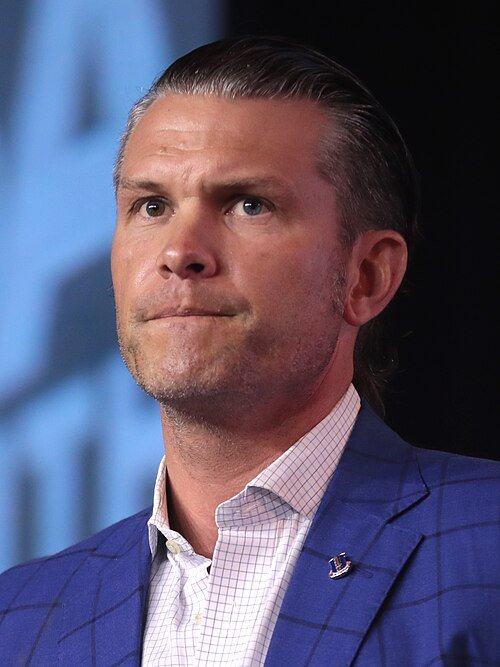
Who is Pete Hegseth?
Pete Hegseth is the U.S. Secretary of Defense, appointed by President Trump in January 2025. Before that, he was a Fox News host, an Army National Guard officer who served in Iraq, Afghanistan, and Guantánamo Bay, and the head of two veterans' advocacy nonprofits. His confirmation was one of the most contested of Trump's second-term Cabinet, passing the Senate only after Vice President Vance cast a tie-breaking vote.
| Born | June 6, 1980 — Minneapolis, Minnesota |
| Education | Princeton University (B.A.); Harvard Kennedy School (M.P.P.) |
| Military service | U.S. Army National Guard, infantry officer; deployments to Guantánamo Bay, Iraq, and Afghanistan; two Bronze Stars |
| Prior career | Fox News host; head of Concerned Veterans for America and Vets for Freedom |
| Office held | U.S. Secretary of Defense (2025–present); uses the title "Secretary of War" |
Two Veterans' Groups, Two Financial Controversies
Before Fox News and before the Pentagon, Hegseth spent nearly a decade running two conservative veterans' advocacy nonprofits. Both ended with financial controversy and his departure — and in the second case, with him personally receiving a payout on the way out.
Hegseth led Vets for Freedom, a pro-Iraq War veterans' advocacy group, from 2007 to 2010. In 2008, the group raised $8.7 million but spent $9.1 million, largely on political spending backing Sen. John McCain's presidential campaign that year23. By early 2009, the organization was more than $500,000 in debt. Its donors chose to wind it down and transfer most of its operations to another veterans' group24.
Hegseth has described the overspending as a "tactical mistake" made in the final push of the 2008 campaign, comparable to how "most political campaigns" end up in debt, and says he personally stayed with the organization until its debts were paid off and outstanding contracts settled25.
Critics point out that running a $400,000 deficit in a single year at a nonprofit is a serious governance failure regardless of intent, and that it set a pattern — a second nonprofit he later led would end in almost identical financial controversy.
Supporters note the group's mission was explicitly political advocacy in a high-stakes election year, that Hegseth stayed to resolve the debt rather than walking away from it, and that advocacy nonprofits commonly run funding shortfalls during major campaign pushes.
Hegseth led Concerned Veterans for America (CVA), a Koch-network-backed advocacy group, from 2013 to 2016. A whistleblower report compiled by former CVA employees in February 2015, later obtained by The New Yorker, alleged financial mismanagement, that Hegseth was repeatedly intoxicated at work events, that he pursued female staffers, and that the organization failed to act on a separate sexual misconduct complaint against another staffer26. Nonprofit filings also showed CVA had hired Hegseth's brother, Philip Hegseth, while Philip was still in college27. Hegseth resigned as CEO in January 2016. Two sources told CBS News he signed a non-disclosure agreement and received a six-figure severance payment on his way out28.
Hegseth has forcefully denied the misconduct and mismanagement allegations, calling them false and describing his exit as a mutual, amicable parting over strategic disagreements about the organization's direction29. A former CVA trustee, Randy Lair, wrote a 2016 letter — later obtained by the New York Post — stating Hegseth "voluntarily resigned" over a "difference of opinion" about the group's future, not misconduct or mismanagement29. His attorney said the NDA was standard paperwork required of every departing CVA employee, not something unique to Hegseth or tied to any wrongdoing28.
Critics argue that regardless of which account of his departure is accurate, Hegseth personally walked away from an organization he's accused of financially mismanaging with a six-figure payout and a legal agreement that kept the details confidential for nearly a decade — an arrangement that insulated him personally while donors and the public were left in the dark. The hiring of his brother while still in college also raises nepotism concerns about how the nonprofit's donor funds were being directed.
Supporters point to the on-record trustee letter contradicting the whistleblower account, note that the New Yorker's sources were anonymous and included a self-described "disgruntled former associate," and argue that a standard severance and NDA — routine at CVA for any departing employee — shouldn't be read as evidence of guilt.
Alcohol Use Concerns
During Hegseth's January 2025 confirmation process, his second ex-wife, Samantha, told the FBI he "drinks more often than he doesn't," and his sister-in-law, Danielle Hegseth, submitted a sworn affidavit alleging she'd witnessed him drink to excess at family gatherings and in public1. NBC News had earlier reported anonymous accounts from current and former Fox News colleagues describing concerning drinking at work events; the FBI's background check reportedly did not interview any of them directly, instead contacting only a Fox News public-relations representative2.
Hegseth has repeatedly and categorically denied having a drinking problem, calling the allegations part of a "coordinated smear campaign," while acknowledging at his hearing he was "not a perfect person." He pledged to abstain from alcohol entirely if confirmed as defense secretary1. His attorney said Danielle Hegseth "hates Pete" and that most of what she described she "didn't in fact witness"1.
Senate Democrats and some ethics watchdogs argued that having a Cabinet-level nominee for the country's largest military bureaucracy promise to personally abstain from alcohol, rather than the concerns simply being resolved as unfounded, was itself a signal the underlying concerns had some substance.
Supporters, including Senate Republicans who ultimately confirmed him, argued the allegations came from an ex-wife and sister-in-law with personal grievances, were never independently corroborated, and that Hegseth's abstinence pledge was a reasonable, good-faith response regardless of the claims' accuracy.
The Tattoo That Got Him Flagged as an "Insider Threat"
Hegseth has tattoos of a Jerusalem cross on his chest and the Latin phrase "Deus Vult" ("God wills it") on his bicep — both symbols with roots in the medieval Crusades that experts say have also been adopted by some far-right and white-supremacist groups in recent years3. Ahead of President Biden's January 2021 inauguration, a fellow D.C. National Guard member, DeRicko Gaither, saw a photo of the "Deus Vult" tattoo and flagged it to superiors as a possible "insider threat" under Army policy banning extremist tattoos; Hegseth's orders to help guard the inauguration were revoked as a result4. He was one of about 12 Guard members removed from that security mission following FBI vetting for extremism concerns5. He left the National Guard shortly after.
Hegseth has said the Jerusalem cross is "just a Christian symbol" reflecting his faith, not an extremist statement, and has described his removal from the inauguration detail as an unjust overreaction in the tense weeks after January 63. The D.C. National Guard's top legal affairs officer at the time separately told the Washington Post the decision was an "overreaction"6.
Extremism researchers note that "Deus Vult" specifically, separate from the Jerusalem cross, has been embraced by neo-Nazi and anti-Muslim extremist movements — the Anti-Defamation League has flagged the phrase on the gunman in a 2023 mass shooting — and argue that a fellow soldier's trained judgment to flag it should be taken seriously rather than dismissed4.
Supporters, including the officer who reviewed the case, argue the Jerusalem cross is a mainstream Christian symbol with a long history well outside extremism, and that removing a decorated combat veteran from duty over a tattoo reflected institutional overcaution, not a real threat.
Sharing Strike Plans Over Signal
In March 2025, The Atlantic's editor-in-chief Jeffrey Goldberg revealed he had been mistakenly added to a Signal group chat of top Trump national security officials, including Hegseth and Vice President Vance, discussing a strike on Houthi targets in Yemen. Hegseth had texted specific attack details — weapons systems, aircraft launch times, and a strike timeline — about two hours before the bombs fell7. The New York Times later reported a second Signal chat, this one including Hegseth's wife and brother, where he shared similar operational details about the same strike8. The Pentagon's acting inspector general opened an investigation into his use of Signal8.
Hegseth said "nobody was texting war plans," maintaining that no classified information was shared in either chat, and dismissed the reporting as "garbage" from a publication he characterized as hostile to the administration9.
Former and current defense officials, from both parties, said sharing precise launch times and weapons details before a strike — over a commercial, non-classified app, with people who had no operational need to know, including family members — would ordinarily be treated as a serious security violation that could put pilots' lives at risk8.
The White House characterized the matter as a technical mistake in adding an extra contact to a chat, not a real security breach, and argued no operation was compromised and no information reached anyone who acted on it maliciously.
Lethal Strikes on Caribbean Drug Boats
Starting in September 2025, the U.S. military, under Hegseth's public direction, began carrying out lethal strikes on boats in the Caribbean and Pacific suspected of trafficking drugs, rather than intercepting and boarding them as past administrations typically did. By December 2025, the campaign had grown to roughly 25 strikes and at least 87–95 deaths10. In the first strike, on September 2, the military carried out a follow-up attack on the same boat after the initial strike left survivors, killing everyone aboard — a "double-tap" that multiple lawmakers and legal experts have said may constitute a war crime11. The administration has not released evidence identifying the people killed or the drugs allegedly onboard for most strikes12.
Hegseth has repeatedly defended the strikes as lawful, writing that they are "approved by the best military and civilian lawyers, up and down the chain of command" and comparing drug cartels to al-Qaeda: "Every trafficker we kill is affiliated with a Designated Terrorist Organization"13. He has said the administration will not release video of the September 2 follow-up strike14.
Human Rights Watch and the UN's human rights office have called the campaign a pattern of extrajudicial killings without legal justification or due process12. Sen. Ed Markey publicly called Hegseth a "war criminal" over the September 2 double-strike and demanded his removal11. At least one strike is reported to have killed a fisherman rather than a trafficker15.
The administration argues traditional interdiction has failed to stop the flow of drugs into the U.S. for decades, that cartels the U.S. has designated as terrorist organizations are legitimate military targets under the laws of armed conflict, and that decisive lethal action, not "kid gloves," is what's needed to stop fentanyl deaths at home.
The Strike on an Iranian Girls' School
On February 28, 2026, the U.S. and Israel launched a large joint military operation against Iran, killing Iran's supreme leader and dozens of officials. During the opening strikes, a missile hit the Shajarah Tayyebeh girls' elementary school in Minab, next to an Islamic Revolutionary Guard Corps naval facility, killing at least 150–175 people, most of them schoolgirls ages 7 to 1216. A New York Times analysis of satellite imagery, timing data, and verified video concluded U.S. forces — which were striking the adjacent IRGC base at the time — were "most likely" responsible, and two U.S. officials told Reuters a preliminary military assessment reached a similar tentative conclusion17. As Secretary of Defense, Hegseth oversees the forces that conducted the operation and is responsible for its official U.S. accounting.
Hegseth said the Pentagon was "investigating" the strike and stated, "We, of course, never target civilian targets"17. President Trump separately blamed Iran for the strike, claiming Iranian munitions are inaccurate, though he presented no evidence for that claim and satellite timing data cited by the Times pointed the other way18.
UN human rights experts called the strike a "grave assault on children" and demanded an independent investigation; Amnesty International said those responsible for what it called an unlawful strike must be held accountable, and that ongoing internet blackouts in Iran have made independent verification difficult19. Critics argue the administration's shifting explanations — first citing an imminent Iranian threat, then blaming Iran for the school strike itself — reflect an effort to avoid accountability for a strike that killed well over 100 children.
Administration officials and supporters note that final responsibility for the strike had not been formally confirmed as of this writing, that the school sat directly adjacent to a legitimate military target, and that even precision strikes on legitimate targets can produce tragic, unintended civilian casualties in wartime without that reflecting deliberate wrongdoing.
Renaming the Pentagon Without Congress
On September 5, 2025, President Trump signed an executive order directing the Department of Defense to be publicly referred to as the "Department of War," authorizing Hegseth to use "Secretary of War" in official communications, signage, and the department's website (rebranded to war.gov)20. Because only Congress has the legal authority to formally rename a federal department, the change is a "secondary title" only — the statutory name remains the Department of Defense unless and until Congress acts21. In December 2025, the House voted to include the renaming in its annual defense policy bill, a step toward making it permanent, though it still needed further congressional action to take full legal effect22.
Hegseth has embraced the change enthusiastically, arguing it "restores the warrior ethos" and reflects a shift toward "maximum lethality, not tepid legality." He and Trump have both said they expect Congress to eventually go along with making the change permanent20.
Critics point out that using an executive order to functionally rename a Cabinet department — new signage, letterhead, and a new public identity — while Congress's role is treated as an afterthought, sidesteps the constitutional separation of powers, regardless of whether the underlying symbolism is popular.
Supporters, including the lawmakers who introduced companion bills to formalize the name, argue the executive order stayed within its lawful bounds by using only a secondary title and explicitly routing the permanent change through Congress, and that the name itself restores a title the department used successfully for over 150 years.
Key Dates
Later commissioned as an Army National Guard infantry officer.
Flagged over a tattoo; leaves the National Guard shortly after.
Passes the Senate only after Vice President Vance's tie-breaking vote, amid alcohol and misconduct allegations.
Strike plans for Yemen shared in a Signal chat that accidentally included a journalist.
Lethal strike campaign launches; Pentagon adopts "Department of War" as a secondary title.
During joint U.S.-Israel strikes on Iran; evidence points to U.S. forces as the likely source.
Included in the annual defense policy bill, pending further congressional action.
Common Questions
Legally, it's still Secretary of Defense — that's the statutory title only Congress can change. He is authorized to use "Secretary of War" as a secondary title by executive order, and does so in most public communications.
Experts are split on how to read it. The Jerusalem cross and "Deus Vult" phrase date to the Crusades and are used by many Christians without extremist intent, but both symbols have also been documented in use by far-right and white nationalist groups. A fellow Guardsman flagged it under military anti-extremism policy, and Hegseth's inauguration security orders were revoked as a result.
A U.S.-Israeli joint operation on February 28, 2026 killed over 150 people, mostly schoolgirls, at a school in Minab, Iran. Evidence, including a New York Times satellite analysis, points to U.S. forces as the likely source, though the Pentagon said it was still investigating and President Trump blamed Iran. Final responsibility has not been officially confirmed as of this writing.